

Old Tax Regime FY 2026–27, New Tax Regime FY 2026–27, income tax slabs, tax planning India, tax regime comparison.
The new regime is the default and has no tax up to ₹12 lakh of taxable income for most residents. The old regime still wins if your deductions are large. Here is how to decide.
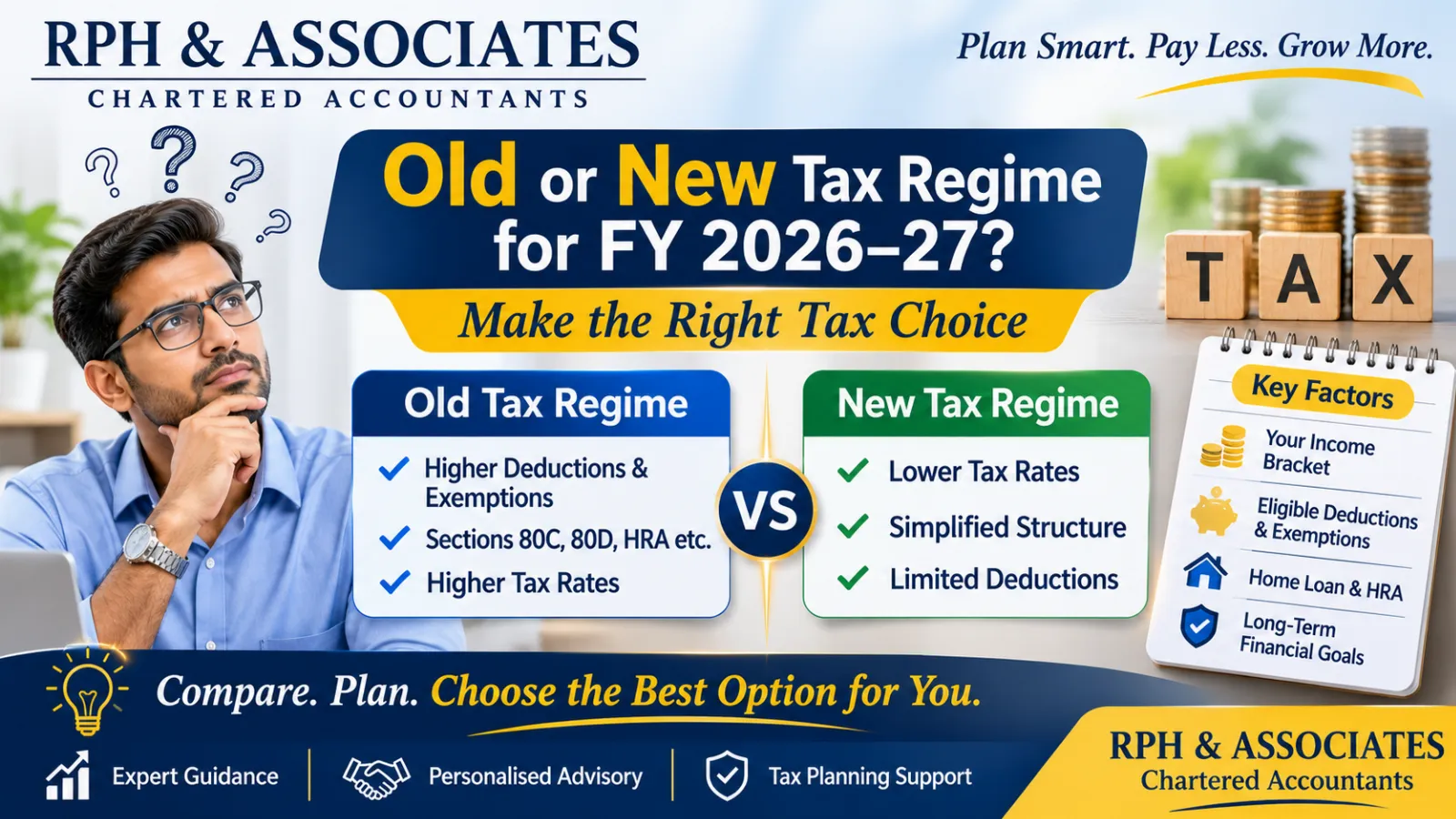
An Insight by RPH & Associates, Chartered Accountants
Introduction
Choosing between the Old Tax Regime and the New Tax Regime is an important tax-planning decision for individuals and Hindu Undivided Families (HUFs). For FY 2026–27, corresponding to Tax Year 2026–27 under the Income-tax Act, 2025, the New Tax Regime continues as the default tax regime.
The New Tax Regime offers comparatively lower tax rates and a simplified structure with limited deductions and exemptions. The Old Tax Regime, on the other hand, allows eligible taxpayers to claim various deductions and exemptions, which may reduce their taxable income substantially.
However, the most beneficial option depends on an individual's income profile, investments, insurance premiums, housing arrangements, home-loan commitments and other eligible deductions.
1. New Tax Regime: Tax Rates for FY 2026–27
Under Section 202 of the Income-tax Act, 2025, the following slab rates apply:
| Total taxable income | Tax rate |
|---|---|
| Up to ₹4,00,000 | Nil |
| ₹4,00,001 – ₹8,00,000 | 5% |
| ₹8,00,001 – ₹12,00,000 | 10% |
| ₹12,00,001 – ₹16,00,000 | 15% |
| ₹16,00,001 – ₹20,00,000 | 20% |
| ₹20,00,001 – ₹24,00,000 | 25% |
| Above ₹24,00,000 | 30% |
Important benefits:
The New Tax Regime is the default option.
Eligible resident individuals can claim the rebate available under the applicable provisions, subject to the prescribed conditions.
Salaried individuals are eligible for the applicable standard deduction.
Certain specified deductions, including eligible employer contributions to retirement schemes, continue to be available subject to conditions.
The regime generally involves fewer tax-planning requirements and simpler compliance.
For eligible resident individuals, the rebate can make normal taxable income of up to ₹12 lakh tax-free. For eligible salaried taxpayers, the applicable standard deduction can increase the effective salary threshold to ₹12.75 lakh, subject to the nature of income and statutory conditions. Income chargeable at special rates, such as certain capital gains, requires separate consideration.
2. Old Tax Regime: Tax Rates for FY 2026–27
The Old Tax Regime continues to provide different basic exemption limits depending on the age and residential status of an individual.
Individuals below 60 years and non-resident individuals
| Total taxable income | Tax rate |
|---|---|
| Up to ₹2,50,000 | Nil |
| ₹2,50,001 – ₹5,00,000 | 5% |
| ₹5,00,001 – ₹10,00,000 | 20% |
| Above ₹10,00,000 | 30% |
Resident senior citizens (60 years to below 80 years)
| Total taxable income | Tax rate |
|---|---|
| Up to ₹3,00,000 | Nil |
| ₹3,00,001 – ₹5,00,000 | 5% |
| ₹5,00,001 – ₹10,00,000 | 20% |
| Above ₹10,00,000 | 30% |
Resident super senior citizens (80 years and above)
| Total taxable income | Tax rate |
|---|---|
| Up to ₹5,00,000 | Nil |
| ₹5,00,001 – ₹10,00,000 | 20% |
| Above ₹10,00,000 | 30% |
Key benefits of the Old Tax Regime:
Eligible taxpayers may claim deductions and exemptions such as:
Investments and eligible payments under Section 80C of the earlier Act framework, including specified provident fund contributions, life insurance premiums and eligible tax-saving investments.
Eligible health insurance premiums under Section 80D.
Eligible interest on housing loans.
House Rent Allowance (HRA) exemption, subject to conditions.
Leave Travel Allowance (LTA), subject to conditions.
Eligible donations and other specified deductions.
Other deductions and exemptions permitted under the applicable provisions.
The availability and limits of these benefits must be checked under the provisions applicable to Tax Year 2026–27.
3. Key Differences Between the Two Regimes
| Particulars | New Tax Regime | Old Tax Regime |
|---|---|---|
| Default option | Yes | No |
| Basic exemption limit | ₹4 lakh | ₹2.5 lakh for individuals below 60 |
| Tax slab structure | Lower and more graduated rates | Higher rates at lower income levels |
| Standard deduction | Available, subject to applicable provisions | Available, subject to applicable provisions |
| Section 80C-type deductions | Generally not available | Eligible deductions available |
| Health insurance deduction | Generally not available | Eligible deduction available |
| HRA exemption | Not available | Available, subject to conditions |
| Self-occupied home-loan interest | Generally not deductible | Eligible deduction available |
| Tax-planning requirements | Relatively limited | Greater scope for deductions and exemptions |
4. Which Tax Regime Is Better?
There is no universal answer. The right choice depends on the amount of deductions and exemptions available to the taxpayer.
The New Tax Regime may be more beneficial when:
The taxpayer has limited tax-saving investments.
There is no substantial HRA or home-loan interest benefit.
The taxpayer prefers a simplified tax structure.
The total eligible deductions under the Old Tax Regime are relatively low.
The Old Tax Regime may be more beneficial when:
The taxpayer makes substantial eligible investments.
Significant HRA exemption is available.
The taxpayer has eligible home-loan interest.
Health insurance premiums and other eligible deductions are substantial.
The combined benefit of deductions and exemptions outweighs the advantage of lower slab rates under the New Tax Regime.
5. Illustrative Example: Comparing Both Regimes
Assume an individual below 60 years has an annual gross salary of ₹15,00,000 and is eligible for the following deductions and exemptions under the Old Tax Regime:
| Particulars | Amount |
|---|---|
| Annual gross salary | ₹15,00,000 |
| Standard deduction | ₹50,000 |
| Eligible investment deduction | ₹1,50,000 |
| Eligible HRA exemption | ₹1,50,000 |
| Eligible home-loan interest | ₹2,00,000 |
| Health insurance deduction | ₹25,000 |
| Total deductions and exemptions | ₹5,75,000 |
| Illustrative taxable income | ₹9,25,000 |
Under the New Tax Regime, assuming the applicable standard deduction of ₹75,000 and no other eligible deductions:
| Particulars | Amount |
|---|---|
| Annual gross salary | ₹15,00,000 |
| Standard deduction | ₹75,000 |
| Illustrative taxable income | ₹14,25,000 |
The final tax liability under each regime must be calculated after applying the relevant slab rates, rebate provisions, cess and any other applicable adjustments. This example is illustrative and assumes all listed Old Regime deductions and exemptions are valid and fully available.
It demonstrates why taxpayers with substantial eligible deductions should not automatically select the New Tax Regime without a comparative calculation.
6. Important Points to Consider Before Choosing
Before selecting a tax regime, taxpayers should:
Estimate their total annual income from salary, business or profession, house property, capital gains and other sources.
Identify all eligible deductions and exemptions.
Consider HRA, home-loan interest, insurance premiums and eligible investments.
Calculate the tax liability under both regimes.
Consider the impact of special-rate income, surcharge and cess.
Review the choice in light of future investments and financial commitments.
Taxpayers should also remember that the procedure and flexibility for changing regimes may differ depending on whether they have business or professional income. The applicable option and prescribed filing requirements should be checked before exercising the choice.
7. Conclusion: Make an Informed Tax Decision
The New Tax Regime may offer a simpler and more beneficial structure for many taxpayers. However, taxpayers with significant eligible deductions and exemptions may still find the Old Tax Regime more economical.
The objective should not merely be to minimise tax for one financial year, but to make a tax-efficient decision that supports long-term financial planning.
A proper comparison of both regimes, based on actual income and eligible deductions, is the most reliable way to determine the better option.
How RPH & Associates Can Assist
RPH & Associates, Chartered Accountants, provides professional tax advisory and compliance services to individuals, professionals, business owners and corporate clients.
Our services include:
Old versus New Tax Regime comparison.
Individual income-tax planning and advisory.
Salary structuring and tax-efficient compensation planning.
Investment-linked tax planning.
Home-loan and HRA tax advisory.
Income-tax return preparation and filing.
Advance tax estimation and compliance.
Plan your taxes wisely. Make informed financial decisions.
RPH & Associates | Chartered Accountants