

GST AMENDMENTS 2026 What Every Business Should Know Effective 1 November 2026 | E-Invoicing Changes from 1 January 2027
GST amendments 2026, GST changes November 2026, GST e-invoicing January 2027 and Post-supply discount GST, GST credit note, inverted duty refund, RCM e-invoicing, GST Rule 14B
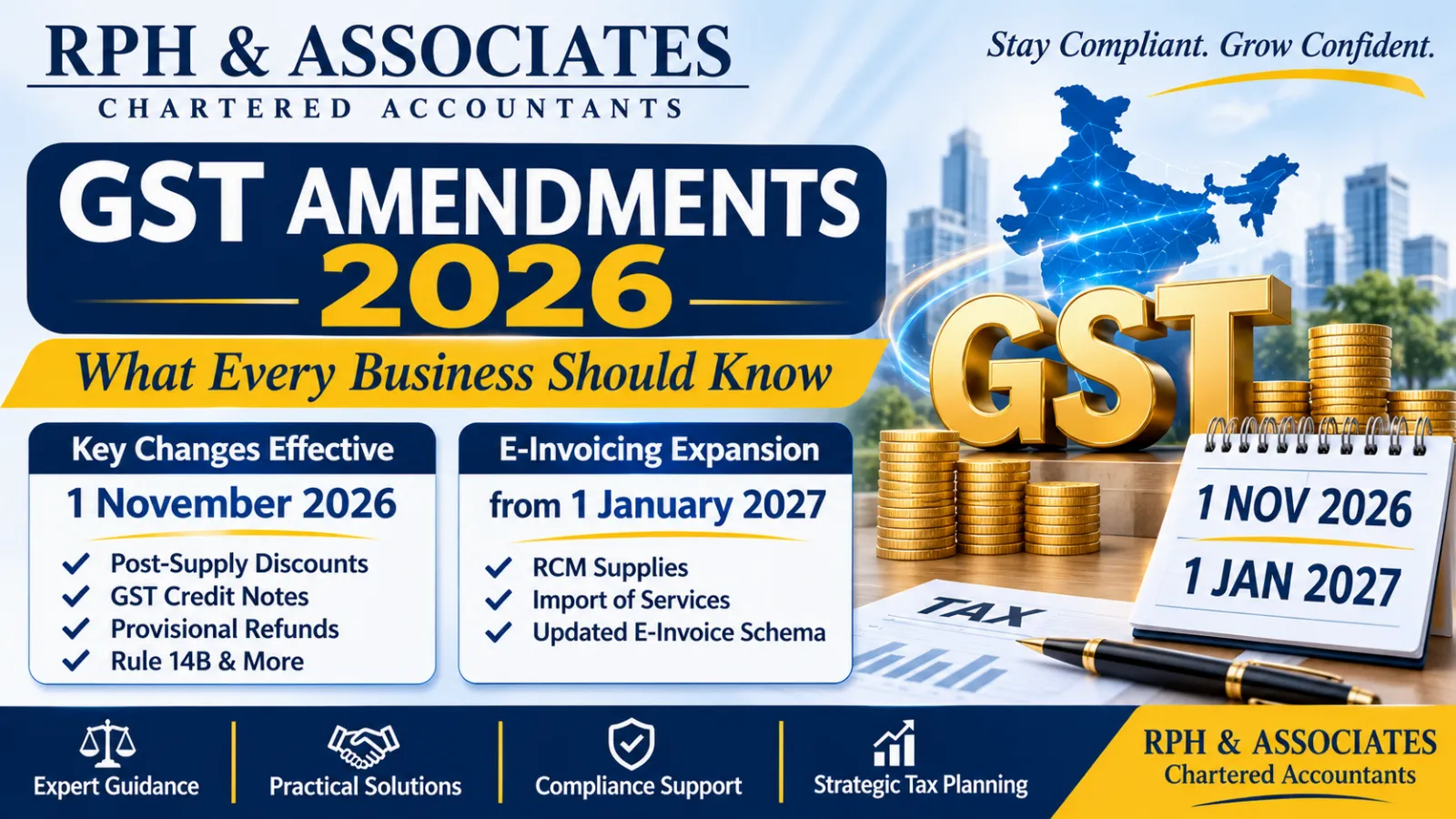
An Insight by RPH & Associates, Chartered Accountants
Introduction
The Government has introduced important amendments to the Goods and Services Tax (GST) framework through the Finance Act, 2026 and the Central Goods and Services Tax (Amendment) Rules, 2026. These changes aim to simplify business operations, improve refund processes, provide greater flexibility in post-supply discounts and strengthen technology-driven GST compliance.
Some important amendments have become effective from 1 November 2026, while a significant expansion of the e-invoicing framework is scheduled to take effect from 1 January 2027.
Businesses, manufacturers, traders, service providers, e-commerce sellers and finance professionals should review these changes and assess their impact on existing accounting, invoicing and GST compliance systems.
1. Post-Supply Discounts: Greater Flexibility under GST
One of the important changes relates to the valuation of taxable supplies where discounts are granted after the supply has already taken place.
Earlier, exclusion of post-supply discounts from the value of supply under Section 15(3)(b) of the CGST Act required, among other conditions, that the discount be established in an agreement entered into at or before the time of supply and specifically linked to relevant invoices.
With effect from 1 November 2026, the amended provision removes the earlier requirement of a pre-existing agreement and specific invoice linkage. The amended framework permits exclusion of qualifying post-supply discounts from the value of supply where the supplier issues a credit note under Section 34 and the recipient reverses the corresponding input tax credit attributable to the discount.
Practical implications for businesses:
Review existing annual and quarterly discount arrangements.
Establish clear documentation for turnover-based and performance-linked discounts.
Issue appropriate GST credit notes wherever the statutory conditions are satisfied.
Ensure recipients reverse the corresponding input tax credit.
Reconcile credit notes with sales registers, purchase registers and GST returns.
Illustration:
A manufacturer supplies goods worth ₹10,00,000 plus GST to a distributor. Based on the distributor achieving an agreed annual sales target, the manufacturer subsequently grants a discount of ₹1,00,000.
Subject to compliance with the amended statutory conditions, the manufacturer may issue an appropriate GST credit note for the discount. The distributor must reverse the corresponding input tax credit attributable to that discount.
This change provides greater flexibility in structuring commercial discount arrangements while maintaining the required GST documentation and ITC reconciliation.
2. GST Credit Notes: Express Recognition of Post-Supply Discounts
Section 34 of the CGST Act has also been amended to expressly recognise the issuance of credit notes in cases involving post-supply discounts covered under Section 15(3)(b).
This amendment aligns the credit-note provisions with the revised valuation framework.
What businesses should do:
Review the terms of existing customer and distributor agreements.
Define eligibility criteria for post-supply discounts.
Establish an approval mechanism for issuing credit notes.
Maintain supporting calculations and customer-wise discount statements.
Obtain confirmation of corresponding ITC reversals from recipients.
Businesses should ensure that commercial credit notes and GST credit notes are appropriately distinguished, as every commercial adjustment does not automatically qualify for a reduction in taxable value.
3. Provisional Refunds for Inverted Duty Structure
Another significant amendment relates to provisional refunds of unutilised input tax credit arising under the inverted duty structure.
Section 54(6) has been amended to extend the provisional refund mechanism, subject to prescribed conditions, to eligible refunds of unutilised ITC covered under Section 54(3), first proviso, clause (ii).
This is relevant to businesses where the tax rate on inputs is higher than the tax rate applicable to outward supplies, resulting in accumulated input tax credit.
Illustration:
A manufacturer purchases raw materials attracting GST at 18% and supplies finished goods attracting GST at 5%. The difference in input and output tax rates may result in accumulation of eligible input tax credit.
The amended provision extends the provisional refund framework to qualifying inverted-duty refund claims, potentially improving working capital availability.
Practical action points:
Review accumulated ITC balances.
Reconcile GSTR-2B, purchase registers and electronic credit ledger.
Verify eligibility of refund claims under the applicable provisions.
Maintain supporting documents and calculations.
Monitor prescribed conditions and timelines for refund applications.
The amendment facilitates access to provisional refunds; it does not make every accumulated ITC balance automatically refundable.
4. Removal of the Minimum ₹1,000 Refund Threshold for Certain Export Refunds
The amendment to Section 54(14) removes the minimum ₹1,000 refund restriction in respect of eligible refunds relating to exports of goods made with payment of tax.
This is a relevant development for exporters, particularly businesses having smaller export consignments or low-value refund claims.
Practical implications:
Eligible exporters may claim refunds even where the amount is below ₹1,000.
Export refund reconciliations should be reviewed.
Shipping bills, tax invoices and export documentation should be properly maintained.
Refund claims must continue to satisfy the applicable statutory and procedural requirements.
The removal of the minimum threshold does not dispense with other conditions governing export refunds.
5. Expansion of E-Invoicing from 1 January 2027
A significant compliance development has been notified through Notification No. 04/2026–Central Tax dated 26 October 2026.
With effect from 1 January 2027, the notified e-invoicing framework is expanded to include:
Supplies received from unregistered persons where the recipient is liable to pay GST under the Reverse Charge Mechanism (RCM).
Import of services.
The amendment expands the specified transaction categories under Notification No. 13/2020–Central Tax.
For taxpayers covered by the existing e-invoicing mandate, this will require attention to recipient-generated self-invoices and their reporting through the prescribed e-invoicing system.
Important areas requiring attention:
Identify domestic purchases from unregistered suppliers attracting RCM.
Identify import-of-service transactions attracting RCM.
Ensure self-invoices are generated as required under the GST law.
Review the applicability of Invoice Reference Number (IRN) generation.
Coordinate with ERP, accounting software and GST system providers.
Update internal controls for invoice reporting and reconciliation.
The applicable turnover threshold and other existing conditions governing e-invoicing continue to be relevant. Businesses should verify their coverage before implementing the new requirements.
6. New E-Invoice Schema and System Readiness
The related amendments also provide for an updated e-invoice schema, Version 1.2, under the prescribed changes to Form GST INV-01.
The updated framework introduces the transaction classifications required for reporting the newly covered RCM transactions.
Businesses should coordinate with their accounting and technology teams to ensure that:
ERP systems are capable of identifying relevant RCM transactions.
Self-invoice data is captured correctly.
Required fields are mapped to the updated schema.
IRN generation and validation processes are tested.
Accounting records and GST returns remain properly reconciled.
Early preparation will help avoid reporting errors and operational disruption when the changes become effective.
7. New Rule 14B: GST Registration Through E-Commerce Operator Warehouses
The CGST (Amendment) Rules, 2026 introduce Rule 14B, providing a registration mechanism for eligible suppliers making supplies of goods through specified e-commerce operators.
A supplier registered in one State or Union Territory may obtain registration in another State or Union Territory, despite having no physical presence there, by declaring the warehouse of an eligible e-commerce operator as the principal place of business.
The facility is subject to prescribed conditions, including:
The supplier must have a valid regular GST registration in the home State where physical presence exists.
Supplies must be made through an eligible e-commerce operator required to collect tax at source under Section 52.
The specified monthly output tax liability on supplies to registered persons, other than persons having the same PAN, must not exceed ₹2.5 lakh.
The e-commerce operator must provide the prescribed consent.
Biometric-based Aadhaar authentication and document verification requirements must be complied with.
Business impact:
This provision can facilitate eligible sellers in expanding their operations across States through e-commerce warehouse networks without necessarily establishing their own physical business premises in each State.
Businesses intending to use this facility should carefully review the prescribed registration conditions, documentation and ongoing compliance obligations.
8. Changes in GST Registration and Cancellation Procedures
The CGST (Amendment) Rules, 2026 also introduce changes to registration amendment and cancellation procedures.
Important developments include:
Substitution of Rule 19 relating to amendment of registration particulars.
Revised procedures for specified registration amendments.
System-based cancellation of registration on a taxpayer's request under the prescribed conditions.
Changes to the grounds for cancellation under Rule 21.
Prescribed procedures for changing the effective date of cancellation.
Certain additional changes relating to suspension, cancellation and revocation under Rules 21A, 22 and 23A are scheduled to take effect from 1 April 2027.
Businesses should not assume that every registration-related amendment becomes effective on 1 November 2026. The specific commencement date of each provision must be checked.
9. GST Compliance Checklist for Businesses
To ensure readiness for the amended GST framework, businesses should consider the following checklist:
Commercial and accounting controls
Review customer discount and incentive policies.
Update agreements and discount approval procedures.
Establish a credit-note approval and reconciliation mechanism.
Monitor recipient ITC reversals.
Refund management
Review accumulated ITC under the inverted duty structure.
Assess eligibility for provisional refunds.
Review export refund claims and supporting documentation.
E-invoicing and RCM
Identify RCM transactions involving unregistered suppliers.
Identify import-of-service transactions.
Review self-invoicing procedures.
Coordinate with ERP and GST software providers.
Prepare for the updated e-invoice schema.
GST registration
Assess eligibility for Rule 14B registration.
Review GST registration particulars.
Update internal procedures for amendment and cancellation applications.
10. Conclusion: Prepare Today for Better GST Compliance Tomorrow
The GST amendments introduced in October 2026 represent important developments in the areas of transaction valuation, credit notes, refunds, registration and e-invoicing.
The revised post-supply discount provisions may provide greater commercial flexibility, while the expanded provisional refund framework can support eligible businesses facing inverted duty structures. The upcoming e-invoicing changes from 1 January 2027 also require businesses to review their RCM documentation and technology systems well in advance.
Businesses should treat these amendments not merely as statutory changes but as an opportunity to strengthen accounting processes, improve tax controls and minimise compliance risks.
Timely review and professional guidance can help businesses remain compliant and financially efficient.
How RPH & Associates Can Assist
RPH & Associates, Chartered Accountants, provides GST advisory, compliance and assurance services to businesses across industries.
Our professional services include:
GST impact assessment and advisory.
GST return review and reconciliation.
Input Tax Credit verification and advisory.
GST refund assistance.
GST audit and compliance review.
E-invoicing and RCM compliance advisory.
GST registration and amendment support.
GST litigation and departmental representation.
Internal controls and GST process review.
Stay compliant. Strengthen controls. Make informed business decisions.
RPH & Associates | Chartered Accountants